


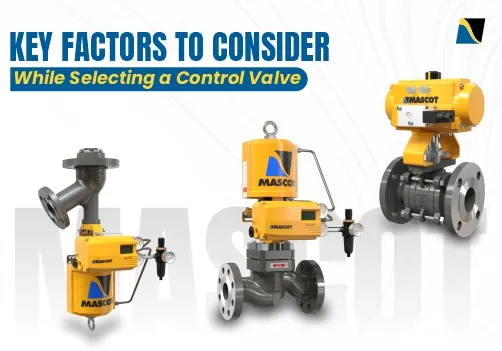
Selecting a control valve is an engineering decision, not a catalogue exercise. A valve that matches the pipe size or pressure rating can still cause poor control, cavitation, high noise, leakage, or frequent maintenance if it does not match the process conditions.
Engineers must evaluate the full application before finalising the valve type, trim, actuator, positioner, material, bonnet, and accessories.
This guide covers the key engineering criteria for control valve selection across process duty, sizing, flow characteristics, severe service, materials, actuation, and compliance.
Selecting the right control valve requires evaluating the process conditions, flow capacity, valve characteristics, materials, severe-service risks and actuation requirements. Correct selection improves control stability, reduces cavitation, noise and leakage, and prevents avoidable maintenance. A structured engineering review helps identify the valve configuration that provides reliable performance and lower lifecycle cost.
1. Define the Process Envelope First
Before sizing or selecting any control valve, the process data sheet must capture minimum, normal, and maximum flow conditions, along with corresponding inlet pressure, outlet pressure, pressure drop, and temperature at each condition. Sizing for design flow only is one of the most common specification errors in control valve procurement.
Engineers should also confirm the fluid type and phase: liquid, gas, steam, slurry, vapour, or two-phase flow. A liquid operating close to its vapour pressure behaves differently from a subcooled liquid or dry steam. Fluid density, viscosity, corrosiveness, solids content, and flashing tendency also affect valve sizing, trim selection, body type, actuator requirement, and material specification.
2. Sizing and the Flow Coefficient (Cv)
In control valve sizing, the flow coefficient, Cv, is the primary parameter used to determine the required flow capacity. It indicates how much fluid can pass through the valve at a given pressure drop. Engineers should size the valve for actual process duty, not simply match it to the pipeline size.
Cv sizing should follow follow ANSI/ISA-75.01.01, accounting for fluid type, compressibility for gases, and correction factors for viscous liquids. Correct sizing should check the Cv at minimum, normal, and maximum flow.
Correct sizing helps improve control valve performance by providing stable control across the operating range without keeping the valve too close to the seat or almost fully open during normal operation.
Oversizing is the more common error. An oversized valve operates near the closed position, where small stem or shaft movements can create large flow changes. This can cause poor controllability, loop instability, hunting, seat wear, and frequent maintenance.
Rangeability also matters. It defines the ratio between the maximum and minimum controllable flow. Engineers should match the required rangeability to the valve type and trim design, especially in applications with wide load variation.
Need to confirm the required Cv, rangeability, and valve size for your process?
Talk to Our Engineering Team3. Flow Characteristics: Inherent vs. Installed
The inherent flow characteristic describes the Cv-versus-travel relationship at constant pressure drop. The installed characteristic is what the valve delivers in the actual process, where pressure drop changes with flow. The control loop responds to the installed characteristic, not the inherent one.
Equal percentage trim suits many process control applications because it provides finer control at lower openings and higher capacity as the valve opens further. Linear trim works better when the pressure drop across the valve remains relatively stable. Quick opening trim is usually suitable for on-off service, not continuous modulation.
The wrong inherent characteristic can create an installed characteristic that changes loop gain across the operating range. When this happens, the loop becomes difficult to tune for both low-load and high-load stability.
MASCOT’s GFlo-Globe Control Valve accepts equal percentage, linear, or modified equal percentage trim to match the installed process duty.
4. Severe Service Conditions: Cavitation, Flashing, and High Noise
Engineers must identify severe service conditions, such as cavitation and flashing, before selecting the valve body or trim. Cavitation, flashing, and high aerodynamic noise can damage the valve, affect control stability, and increase maintenance costs.
Cavitation occurs when pressure drops below the liquid’s vapour pressure and then recovers downstream. Vapour bubbles collapse and can erode the trim, body, and piping. The sigma ratio (σ), calculated per ISA 75.01.01 or IEC 60534-8-4, quantifies severity level of cavitation risk at the design operating point. For high-pressure drop liquid service, Mascot’s CavFlo cavitation control trim reduces pressure in stages to keep the local pressure above the vapour pressure threshold.
Flashing occurs when downstream pressure remains below the vapour pressure, causing two-phase flow after the valve. This leads to erosion, vibration, and noise, so engineers must review body configuration, outlet velocity, and hardened trim material selection carefully.
High noise occurs in gas or steam service when pressure reduction creates high velocity and turbulence. IEC 60534-8-3 provides the prediction methodology for aerodynamic noise. For applications where process data confirms high noise levels, Mascot’s MegaFlo noise attenuation trim reduces sound pressure through multi-path, multi-stage pressure reduction.
5. Valve Body Type, Trim Selection, and Material Compatibility
The valve body type should match the control duty and process media.
A globe control valve, such as Mascot’s GFlo, suits precise throttling, high-pressure drop applications, and services that need specialised trims. A segmented V-notch ball valve, such as VFlo, provides high rangeability and works well for dirty, viscous, slurry, and pulp media. An eccentric plug valve, such as EFlo, suits erosive service, slurries, and solids-laden fluids. A high-performance butterfly valve, such as DiskFlo, suits high flow and light throttling applications.
Trim selection is equally important. The trim directly controls flow and takes much of the wear in throttling service. Engineers should consider:
Full area or reduced trim
Anti-cavitation trim
Noise attenuation trim
Hardened trim materials for erosion and corrosion resistance
Seat leakage class per ANSI/FCI 70-2
Material compatibility must cover the body, trim, seat, packing, gaskets, bolting, and bonnet. Corrosive chemicals, high-temperature steam, cryogenic fluids, abrasive slurries, and hazardous media all require specific material review.
Select the valve body and trim based on actual service conditions—not line size alone.
Discuss Your Valve Requirements6. Actuator and Positioner Selection
The actuator and positioner determine how accurately the valve responds to the control loop. The actuator must provide enough thrust or torque to move the valve under process pressure, hold position against fluid forces, and achieve the required shutoff.
Engineers should define:
Fail-open, fail-close, or fail-last position
Pneumatic or electric , or hydraulic actuation
Required stroke speed
Available air supply
Control signal type: 4–20 mA, HART, fieldbus, or discrete
Manual override requirement
Accessories such as solenoid valves, limit switches, or position transmitters
Mascot’s Linear Actuators and Rotary Actuators support the required motion for globe, plug, V-notch ball, and butterfly control valves. HiFlo-Positioners support pneumatic or electro-pneumatic control signals. SmartFlo-Smart Positioners add HART communication, diagnostics, and valve signature capability where digital valve monitoring is required. XFlo-position transmitters and limit switches provide valve position feedback for control loops and safety systems.
7. Bonnet Selection for Temperature Extremes and Emission Control
Bonnet selection affects packing life, leakage control, and valve reliability. Standard bonnets suit many general services, but extreme temperatures or hazardous media need special designs.
Extended bonnets help protect packing from excessive heat or cold. Cryogenic bonnets isolate the packing from very low-temperature fluids. Bellows seal bonnets reduce fugitive emissions and help contain hazardous or toxic media. For services subject to fugitive emission regulations, bellows seal bonnets support compliance with ISO 15848 and TA-Luft requirements.
For steam, cryogenic service, vacuum-jacketed systems, or emission-sensitive chemicals, engineers should confirm bonnet selection at the specification stage. Changing the bonnet after order placement typically requires major valve modification.
8. Ease of Maintenance and Lifecycle Cost
The lowest purchase price does not always deliver the lowest lifecycle cost. A valve that needs frequent shutdowns, trim replacement, packing adjustment, or actuator maintenance can cost more over time.
Maintenance-friendly selection should consider:
Top-entry trim access
Replaceable seat and trim
Spare parts availability
Interchangeability of components
Access around the actuator
Packing adjustment requirements
Calibration simplicity
Local service support
For example, a valve with accessible trim and standardised spare parts can reduce downtime during planned shutdowns. This matters in oil and gas, power, chemicals, pharmaceuticals, LNG, and other process industries where unplanned stoppage carries a high operating cost.
9. Safety and Regulatory Compliance
Safety requirements must guide control valve selection. Hazardous areas, high-pressure systems, fire-risk zones, and critical shutdown duties need appropriate valve design and accessories.
Engineers should review applicable requirements such as:
Pressure class and pressure boundary per ASME B16.34 and ANSI/FCI 70-2
Fugitive emission compliance: ISO 15848, TA-Luft, API 624
Fire-safe design per API 607 where applicable
Explosion-proof accessories for hazardous areas
Material traceability
Documentation and testing requirements
Plant safety philosophy
Mascot Valves holds ISO 9001:2015, ISO 14001:2015, ISO 45001:2018, ATEX 2014/34/EU, and PED 2014/68/EU certifications. These certifications support quality, safety, environmental, hazardous-area, and pressure equipment expectations for industrial valve supply.
Need help selecting the actuator, bonnet, accessories, and compliance requirements as one complete valve package?
Talk to Us10. Choosing the Right Manufacturing Partner
The right manufacturing partner should support valve selection, not just supply a product code. For specification and application engineers, supplier capability matters because errors in sizing, trim, actuation, or material selection can affect control performance after commissioning.
A reliable control valve manufacturer should provide:
Clear technical specifications
Certification and compliance transparency
Inspection and testing support
Long-term spare parts availability
After-sales technical assistance
A broad product range for different process duties
Mascot Valves has manufactured industrial flow control equipment since 1972, with production facilities in Ahmedabad, India, and Houston, Texas.
The product range covers globe valves (GFlo), eccentric plug valves (EFlo), V-notch ball valves (VFlo), butterfly valves (DiskFlo), flush bottom valves (FlushFlo), desuperheaters (DeFlo), linear and rotary actuators, pneumatic and HART-communicating positioners, and severe-service trims including CavFlo and MegaFlo.
This range allows engineers to match valve selection to actual process duty across a full range of operating conditions and industries.
Conclusion
Selecting a control valve requires a structured engineering review. Start with the process envelope, calculate the Cv, check the installed flow characteristic, evaluate severe service risks, and then finalise the valve body, trim, materials, actuator, positioner, bonnet, and safety accessories.
Sequence matters: an incorrect Cv calculation leads to wrong trim selection, which causes actuator mismatch and poor control performance. Skipping specification steps produces valves that pass on paper but underperform in service.
For critical applications, engineers should involve the valve manufacturer early to avoid oversizing, incorrect trim selection, actuator mismatch, material failures, and avoidable maintenance problems.
MASCOT Valves supports engineers with control valves, severe-service trims, actuators, positioners, and application-specific valve selection for process industries. Contact us to review your process requirements and select a control valve configuration suited to your application.

